
What Is Information Processing Theory?
Discover how Information Processing Theory shapes learning, memory, and training, plus tips for applying it in classrooms, corporate programs, and tech.
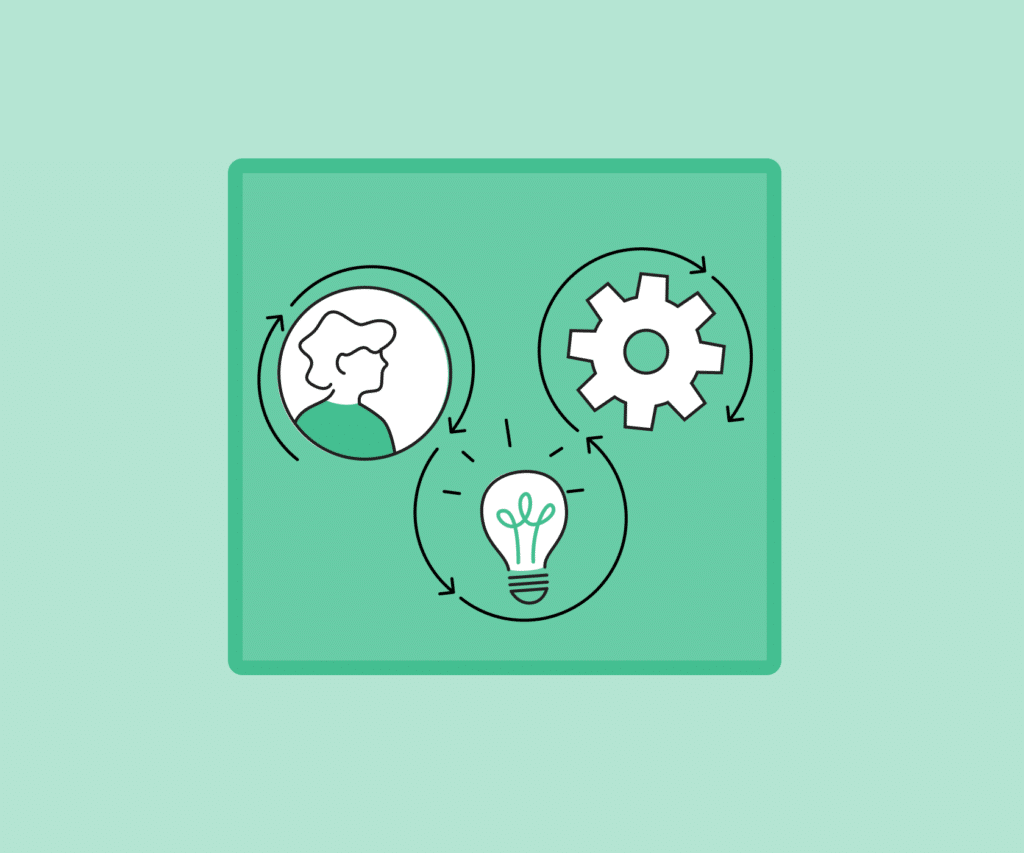
Cracking the code of how we learn
Information Processing Theory offers us a framework to better understand how people intake, store, and retrieve information from their memories. The model includes three stages of human cognition: sensory memory, working (or short-term) memory, and long-term memory. The theory compares human cognition to how computers handle data through input, processing, and storage.
Information Processing Theory offers thorough insights for anyone who teaches or learns, from classroom instructional design to corporate training to educational technology. We all benefit from understanding how people absorb, retain, and retrieve knowledge.
In this blog post, we’ll explore Information Processing Theory’s history, break down its core components, explore practical applications, and look ahead to its future.
Key Takeaways
- Learning is a process. Memory and understanding happen in stages, and effective learning designs reflect how the brain naturally processes information.
- Connection leads to retention. Linking new knowledge to existing experiences, emotions, or real-world applications makes learning last.
- The future combines brain and tech. AI, neuroscience, and cognitive insights will reshape how we teach, train, and support learning, while keeping the human mind at the forefront.
History and foundations of Information Processing Theory
Early cognitive psychology roots
In the early 20th century, psychology began to move beyond behaviorism, or the idea that behavior could be explained solely through observable actions. But researchers soon turned their attention to how people actually think, process, and remember. This shift paved the way for cognitive psychology and, eventually, Information Processing Theory, a framework that positions learners as active participants who filter, organize, and store information.
George A. Miller and the computer metaphor
George A. Miller, one of the founders of cognition studies, posited that one’s working memory can hold up to “seven plus or minus two items” at a time. His research revealed the limits of short-term memory and led to new ways of thinking about cognition. Around that time, the inception of computers offered a useful metaphor. Just as machines take in input, process data, and store it, so does the human mind. It was a simple comparison that made complex mental functions much easier to understand.
Evolution through decades (1950s through present)
The theory has continued to evolve alongside technology and neuroscience. While early models described memory as a linear flow from sensory input to long-term storage, later developments added nuance, including the roles of attention, emotion, and parallel processing. Today, Information Processing Theory remains a popular framework, offering a bridge from classic psychology to modern approaches in education, workplace learning, and even artificial intelligence.

Core components and cognitive stages
Information Processing Theory acknowledges three stages: Sensory memory, working memory, and long-term memory.
Sensory memory: Input and perceptual filters
Every learning experience begins with sensory input, or what we see, hear, or feel in the moment. Our sensory memory acts as a filter, holding that information for just a second or two. That means that only the details we pay close attention to move forward for further processing, while the rest quickly evaporates.
Working/short-term memory: Processing limitations
Once information passes through that initial filter, it enters what’s called the “working memory.” This stage is powerful but also limited, as it can hold only a few bits of information at a time—think back to Miller’s “seven plus or minus two” idea. However, strategies like chunking, repetition, and the use of visual aids help expand those limits and make new information easier to retain.
Long-term memory: Encoding and retrieval
Effectively processed information moves into long-term memory, where it can be stored for days, years, or even a lifetime. The ability to access that knowledge when needed (i.e., “retrieval”) depends on how well it was initially encoded. Connections to prior knowledge, meaningful practice, and varied recall opportunities all increase your chances of remembering information when you need to.
Practical applications in education and training
How can you apply Information Processing Theory in real-life situations?
Instructional design strategies (multi-sensory, repetition, chunking)
Instructional designers frequently use Information Processing Theory to create lessons that actually stick. Multi-sensory approaches, such as combining audio, visuals, and hands-on activities, capture attention at the sensory stage. You can reinforce learning through repetition and increase its chances of moving into working memory, while chunking breaks content into manageable pieces that are easier to process and remember.
Corporate training examples: Retention and engagement
Workplace training programs that are built on these principles tend to lead to better retention and engagement. For instance, reinforce new skills through spaced practice, role-playing, or scenario-based learning to help employees apply what they learned when back on the job. The result is less wasted training time and better performance outcomes.
Educational technology: Enhancing memory retention (e.g., spaced learning)
The world of educational technology is also applying these concepts in new and innovative ways. Platforms that use techniques such as spaced repetition, adaptive quizzing, or interactive simulations leverage memory science to improve long-term retention. By using technology in conjunction with how the brain processes information, educators and employers alike can make learning more effective.
Limitations and criticisms of Information Processing Theory
This theory is a powerful tool to understand how we learn, but it’s not without critiques, including:
Over-simplification via computer analogy
While the computer metaphor made information processing theory easier to understand, it can also be somewhat misleading. Human cognition isn’t as simple or as straightforward as a CPU. Human thought patterns are messy, contextual, often biased or subjective, and complex in ways that go far beyond simple input and output.
Ignores emotional and motivational factors
The theory also struggles to account for human emotions and motivations when it comes to learning. A learner’s interests, stress levels, or sense of purpose can dramatically influence how well they process or remember information.
Cognitive parallel processing vs. serial processing comparison
Another common problem with the theory is that it often assumes that information moves in a linear, step-by-step fashion. In reality, the brain processes multiple streams of information simultaneously, blending perception, sensation, and reasoning. This means that while the framework is certainly useful, it paints an incomplete story of how we think and learn.
Global and organizational perspectives
Organizational information processing frameworks in business
In the business world, the concept of information processing doesn’t just apply to individuals. It refers to organizations as a whole. Many companies now use frameworks either directly or indirectly inspired by the theory to better understand how teams collect, share, and use information. When communication channels are clear and data flows efficiently, organizations tend to make better decisions and adapt more quickly to change.
Cross-border educational implementations
Globally, education systems apply Information Processing Theory in many different ways. Whether designing a curriculum or training teachers, the framework gives a structure to learning that helps individuals absorb and retain the material. What’s more, its principles have proven fairly universal, so it can be adapted to fit local contexts.
Culture considerations in information encoding
Culture shapes not just what we learn, but also how we process it. For example, storytelling traditions, language structure, and even societal norms and values all influence how we encode and recall information. Recognizing these differences ensures that learning strategies are inclusive and effective for diverse learners.
Future directions and emerging trends in 2026
AI and cognitive modeling in learning systems
Artificial intelligence is transforming how we apply Information Processing Theory. Today’s AI-powered learning platforms can model cognitive processes, help personalize instruction, and boost retention by analyzing how learners interact with content in real time.
Ethical considerations in digital cognition and data
As technology collects more and more cognitive data, many ethical questions will continue to arise. For example, how do we ensure privacy, avoid bias, and use these insights responsibly? These considerations are crucial as digital learning systems become increasingly sophisticated.
Research frontiers: Integrating neuroscience and IP theory
The next wave of research is blending neuroscience with Information Processing Theory to reveal how our brain networks support things like memory, attention, and decision-making. By combining psychological models with biological evidence, we can start to design even more effective learning experiences and understand the limits and potential of human cognition.
What we’ve learned about how we learn
Information Processing Theory offers more than a model of memory. It’s a lens for better understanding how we think, learn, and adapt. From classrooms to corporate training, it offers a guide to designing learning experiences that actually have a lasting impact. As technology and neuroscience continue to evolve, this theory reminds us that learning isn’t just about data. It’s about making connections, shaping new habits, and unlocking human potential.
Ready to move past boring, forgettable learning? Check out our post, Beyond The Information Dump: Create Engaging Learning, and discover strategies to make learning truly memorable.
You may also like

How to Boost Sales Performance With Hybrid Training
Learn how to train your sales team with a hybrid approach that’s flexible, scalable, and performance-driven.
Why and How to Make Employee Training More Challenging
Explore the science behind productive struggle and how to make employee training harder for better, lasting learning.

How to Conduct a Skills Gap Analysis
Need help with skill gaps? Our step-by-step guide shows you how to conduct a skills gap analysis and effectively align your workforce with business goals.