
Informed Is Not Equipped
What every Sales and Customer Success leader needs to know about product enablement

Monika Saha
Chief Commercial Officer, Articulate
- Executive summary
- The pace changed & the model has a real opportunity to catch up
- The instructional design difference
- The reach constraint unlocked
- Putting it to practice: Old world vs. new world
- Two principles for what good looks like
- What this looks like at scale
- Two places to start
- The system worth building
- The bottom line
Executive summary
Before AI, a training deck built in January was still mostly accurate in March. That world is gone. Features ship continuously now, and the gap between a product shipping and a customer-facing team feeling ready to talk about it used to be weeks. The expectation today is days. Most of us are still running an enablement model built for the older cadence, and the good news is that the tools to change that model are finally here.
What I keep coming back to is this: being informed and being equipped are not the same thing. Both matter. But only one of them builds the capability to react well to whatever situation a customer puts in front of you. That should change where enablement budgets go. For years, most of our enablement budget went into making sure the answer existed somewhere: decks, docs, recordings, knowledge bases, content management systems. That was the right call at the time, because information was genuinely hard to find. It is not anymore. AI answers the how-do-I question in seconds. If someone needs to know how many languages a feature supports, that is a question for a search bar, not a training module. So the resources we have been spending on transferring information should be reinvested in situational learning. That type of learning is what actually builds capability.
The principles behind that kind of situational learning are not new. Frameworks like earner-centered design, retrieval practice, scenario-based learning, and spaced repetition have 40+ years of research and proven success behind them. What held teams back from using these frameworks often was never willpower. It was specialist expertise, capacity, and tooling. Building scenario-based training often took weeks and required specialist expertise most enablement teams did not always have on staff. That constraint has gotten dramatically less binding in the last two years.
Subject matter expertise about the topics you need to train your teams on has always existed. What is new is the capacity to turn that subject matter expertise into learning that reaches everyone who needs it, at the pace the business actually moves.
In summary
- Being informed and being equipped are not the same thing. Most CS enablement has been optimized for the former, and for good structural reasons.
- AI has accelerated the pace of product change. The opportunity is to build a training model that finally keeps pace.
- The instructional design principles that build real capability are now accessible at scale for the first time.
- Build for the situation: for CSMs, that is the customer conversation; for customers, it is value at the moment of adoption.
- Practice beats certification. Continuous beats one-time. Both are now achievable without a large instructional design team.
The pace changed & the model has a real opportunity to catch up
Before AI, a training deck built in January was still mostly accurate in March. Products shipped less frequently, and customer-facing teams had time to absorb product knowledge, ask questions, and practice in low-stakes conversations with their managers or enablement leads before taking high-stakes calls with customers.
Today, products evolve continuously. Workflows change not just at the user experience level, but at the level of how a customer actually does their job with your product. The gap between a product shipping and a salesperson or customer success manager feeling genuinely confident about how to talk about that product used to be weeks. The expectation now is days. The training model most organizations are running was built for the older cadence, and the good news is that the tools to change that model are now available.
The pace of change changed. Now, for the first time, the training model can keep up with it.
When a feature ships on Tuesday and customer-facing teams needs to be ready the following week, building a deck or scheduling a Zoom session was the right call given the constraints. It was fast, it scaled, and it transferred information effectively. The shift now is that those same constraints no longer apply in the same way. Building situational, practice-based learning at speed is now possible, and that raises the bar on what good enablement looks like.
The instructional design difference
Instructional design is not a new field. Its core principles have been validated across more than forty years of research, and four of them are worth naming here because they are the foundation that practice-based enablement is built on.
Learner-centered design:
Starts with the performance gap, not the content inventory. The question is not what does this feature do, but what does an individual need to be able to do in front of a customer after this training.
Retrieval practice:
Learning sticks when people are forced to recall and apply it, not when they read it. The act of remembering builds durable memory in a way that passive consumption does not.
Scenario-based learning:
Context-rich practice that mirrors the real situation transfers to real-world performance. If the goal is for sales and customer success representatives to handle customer objections with confidence, the practice needs to be in simulated customer objections, not descriptions of them.
Spaced repetition:
A single enablement session does not create retention. Distributed practice over time does. A training webinar, however well-designed, is a starting point.
These principles are not new. The reason most organizations have not applied them at scale to every feature release is reach, capacity, and tooling. Building scenario-based, retrieval-focused training often took weeks per module and required specialist knowledge that most enablement teams did not have on staff. They built what they could, and they built it well given the tools available. What has changed is that the tools themselves have become more sophisticated.
It was a structural constraint, not a willpower problem. That constraint has gotten significantly less binding in the last two years.
The reach constraint unlocked
There have always been two ways to get someone ready for a customer conversation. Before AI, only one of them was feasible at scale.
Information was hard to find, so organizations spent their enablement budget making sure the answer existed somewhere: decks, docs, recordings, knowledge bases. That was the right call for the constraint. Building learning around the actual situation someone would face, something scenario-based, practice-oriented, and contextually grounded, took weeks per module and required instructional design expertise most teams did not have readily available. So it did not happen at scale.
That balance has shifted. Retrieval is now largely solved. AI answers the how-do-I question in seconds, and people can access product information faster than a 40-slide deck could ever deliver it. The effort that used to go into front-loading information transfers to a different problem: building for the situation. With information retrieval resolved, the problem AI clearly reveals is access to information does not mean comprehension, retention, and ability to implement consistently at the pace of product change.
The work of creating enablement grounded in learning science used to be time-intensive and specialist-dependent. It is now within reach. The instructional design principles, the scenario structures, the feedback mechanisms are now embedded in the tools available to build training. What has always been in the room, the subject matter expertise, the knowledge of what customer objections actually sound like, what situations customer-facing teams actually face, has not changed. That knowledge is still yours. The tools to quickly and easily turn it into practice-based learning at scale are now here.
Here are some examples of the types of things that dramatically improve the effectiveness of enablement:
1. Scenarios:
Practice grounded in the actual situation a sales or customer service representative will face, not a generic objection or a hypothetical customer.
2. Branching simulations:
The simulation responds to what the salesperson or CSM actually says, so the practice feels like a real conversation rather than a script to memorize.
3. Immediate feedback:
The salesperson or CSM learns what worked and what didn’t at the moment of the response, before that moment ever happens with a real customer.
These are not new ideas. They are the elements that have always produced high quality training capability. What is new is that building with them no longer requires a specialist team or a weeks-long production cycle.
What’s changing is the capacity to turn it into learning that reaches everyone who needs it, at the pace the business actually moves.
Putting it to practice: Old world vs. new world
To make this concrete, consider a single product launch and two different ways of enabling the people who need to be ready for it.
The traditional approach
Most organizations start in the same place: the technical documentation team’s write-up on a new product . It is accurate, complete, and shows up in search when customers know what to look for. It is exactly what it is designed to be: a reference for people who already know a new product exists and want to understand it in depth.
From there, someone in enablement takes that foundational knowledge and builds an internal deck. It covers what the product does, how to access it, the options available, and an FAQ. Every slide delivers information. There may be a knowledge check at the end with multiple-choice questions that confirm the salesperson or CSM has read the material. Passing confirms recall of product specifications. It does not build the confidence needed to navigate a live customer conversation about the product.
Consider a salesperson or account manager in a customer conversation. Their champion says that they would love to invest in the newest product, but it is just not in the budget this year. The agenda moves on. The deck built to convey information about the new product did not prepare the team for that moment. The certification quiz did not either. That is not a team failure. It is an enablement design opportunity.
A practice-based approach
The same product launch, the same source material, designed differently.
Instead of a deck, the account teams engage with the content through an AI tutor that asks questions, surfaces gaps, and draws them through the material via dialogue rather than passive reading. The information is the same. The cognitive engagement with it is fundamentally different.
Then, rather than a multiple-choice quiz on feature specifications, the salesperson or CSM is placed directly in the moment they will actually face. The customer’s budget objection is voiced in a simulation. The salesperson or CSM responds. AI evaluates that response immediately against the specific conversational behaviors the enablement leader has defined: ask a clarifying question, identify the value the customer may be missing, reframe the cost in context, close with a question rather than a pitch.
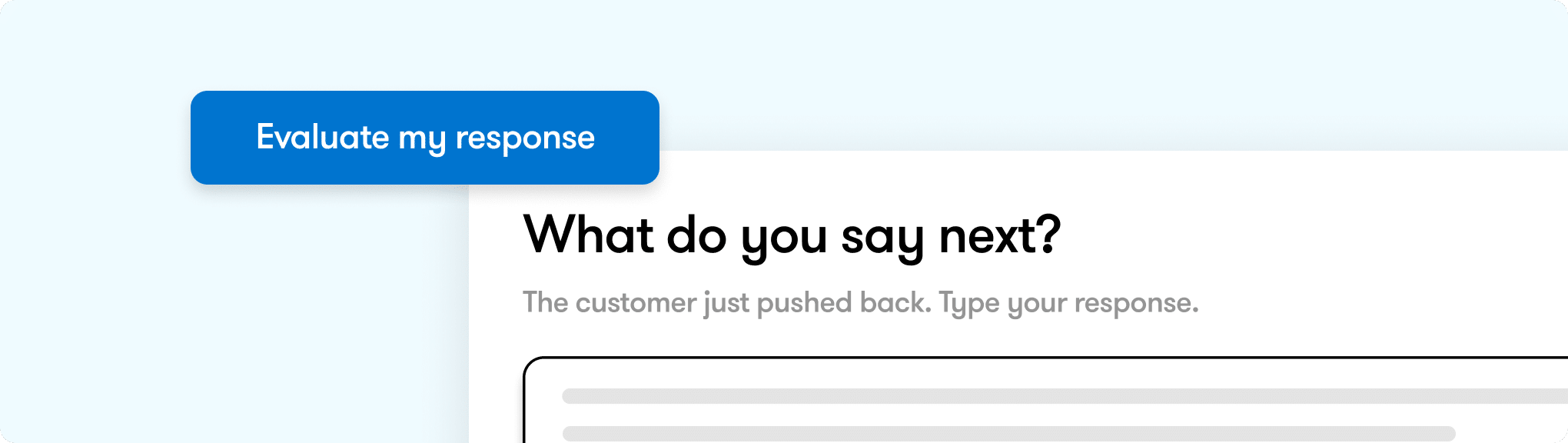
A snapshot of AI Tutor in a real CSM use case scenario
They then enter the next customer conversation having already practiced that moment. The feedback loop has happened before an anticipated objection is raised.
Two principles for what good looks like
If practice-based, situational learning is the goal, two principles define what good looks like. Neither is new. What is new is that building to them is now realistic for most organizations.
10%
Retained from passive consumption — watching a video, reading a deck, attending a webinar.
75%+
Retained from active practice — simulations, retrieval exercises, scenario-based learning.
That gap is the difference between a CSM who watched the enablement session and a CSM who is ready for the conversation.
Practice beats certification
A certification quiz tests recall: did the salesperson or CSM watch the video, can they identify the correct answer. A simulation tests response: it is built around your product, your customers’ actual objections, your team’s real conversations. The output of a well-designed simulation is genuine confidence which goes far beyond a completion checkbox.
Continuous beats one-time
A long onboarding module built for completion rarely produces situational confidence. Retention is uneven, and even where it holds, applying knowledge in context is a different skill than recalling it. The teams seeing the strongest results build microlearning tied to multiple business catalysts: product releases, macro market trends, capability gaps surfaced from conversation analysis, renewal cycles that need reinforcement. This does not mean more content. AI-generated content that is not grounded in your product, your customers, and real frontline conversations creates noise rather than capability. The goal is a better learning system, one that continuously builds on the expertise already in the organization. The organizations getting this right are treating learning as operating infrastructure, not a project queue. When that shift happens, learning keeps pace with the business instead of chasing it.
What this looks like at scale

ResultsCX
Training customer service agents worldwide
Challenge
Diverse global clients. A shifting workforce population whose training needs have evolved. A deep need for real-world practice in training to prep reps for complex customer conversations.
The Shift
Scalable, accessible training that meets reps where they are. Courses give them opportunities to practice complex scenarios, improving skills and building muscle memory before the live call.
Result
15–20% improvement in agents’ QA scores post-training. 30–40% faster new hire proficiency. 10–20% improvement in first call resolution rate. The team’s impact goes beyond faster development—with the right content, mindset, and tools, ResultsCX delivers training that resonates with reps and drives real results.
Two places to start
The shift to practice-based, situational enablement is one most organizations can begin immediately. Two starting points are worth prioritizing.
Build for the situation, for CSMs
A salesperson or CSM’s job in a customer conversation is not to recall product specifications. It is to listen, identify what the customer is missing, and connect the product’s value to the customer’s specific situation. Enablement built for that job looks like simulated conversations grounded in real objections, feedback that evaluates situational response rather than factual recall, and practice opportunities short enough to complete in the same week a feature ships.
Product information should be easy to access on demand. If a salesperson or CSM needs to know how many languages a feature supports, that is a question for a search bar or a generic AI tool. Stop spending enablement resources on building things that simply transfer information, and reinvest that time in building situational training that prepares teams for real scenarios.
Build to show value, for customers
Every product launch is an opportunity to show customers what they can now do that they could not before. The question to ask before any launch: where does the customer first encounter this feature, and what do they see at that exact moment? Whether it is a clear statement of value or a wall of documentation makes a significant difference in whether customers understand and adopt what you have built for them.
Field readiness and customer value framing should draw from the same knowledge foundation: the technical documentation, the product marketing material, the key use cases. Two outputs designed for two different audiences, both available in the same launch week.
Build for the situation: for CSMs, that is the customer conversation; for customers, that is the moment they first meet the feature. Both require design. Both are now achievable.
The system worth building
Sales, Customer Success, and Enablement leaders are better positioned than anyone else in their organization to close the gap between product knowledge and team confidence. They know the conversations, the objections, and the moments where preparation makes a measurable difference. What has changed is that the tools to build toward that preparation at scale are now available, and applying the instructional design principles that have always worked no longer requires a large specialist team or a months-long production cycle.
The organizations that build this well are the ones whose teams walk into customer conversations with genuine confidence, whose customers clearly understand a product’s value, and whose teams can absorb change as fast as the business generates it because they built an enablement system that scales.
That is what being ready looks like. The design principles to create this have always been around. The tools to infuse these principles across all enablement programs at scale are finally here.
The bottom line
- Being informed and being equipped are distinct. Both matter. Only one prepares a customer-facing team for a live customer conversation.
- Practice beats certification. Simulation tests response; certification tests recall.
- Continuous beats one-time. Match the training cadence to the product and market cadence.
- Build for the situation. Start with what the salesperson or CSM needs to be able to do.
ABOUT THE AUTHOR

Monika Saha is Chief Commercial Officer at Articulate, leading Sales, Marketing, Go To Market Effectiveness, and Customer Success. She brings over two decades of experience from Gainsight, Zuora, and Delphix, and has been one of the most intentional voices in the industry on how organizations can move from talking about AI to genuinely building around it.