
Information Sharing Isn’t Enablement
How to actually build readiness at launch speed

Sam Shoemaker
Senior Director, Sales and Business Development, Articulate
Overview
Most of my career has been spent in rooms where the pressure is immediate and the scoreboard is public. Fifteen years across AMEX Global Business Travel, Expedia, and Groupon. Companies that were constantly building new products, entering new markets, and asking their revenue teams to keep up.
I liked that pace, I understood it, and I thought I understood what it took to bring a team along through a product launch: get the messaging right, build the deck, run the live session, send the recording, move on.
I, along with most other revenue leaders, accepted that there was always going to be a gap between what information we were providing and what actually stuck with the team. We treated it as the cost of doing business, an unavoidable friction between product velocity and field readiness. It was this problem, compounded over years, with many deals compromised or lost, for me to realize that gap wasn’t inevitable. It was a choice we were making every time we confused information distribution with actual preparation.
AI is making your product team faster. It is not making your revenue team faster.
Here’s what’s happening at companies across every industry right now: AI is compressing product development timelines that used to take years into months, and months into weeks.
Duolingo went from writing 1,800 course units per quarter manually in 2024 to using AI to produce over 20,000 units in Q1 2026. Salesforce shipped five major platform releases in 12 months. Outreach went from three product releases per month in 2022 to 12 in 2025.
That’s four times the releases. Four times the features. Four times the value and volume of new context your team is supposed to carry into customer conversations.
4x
the releases. The features. The gap.
And four times the gap between what your product can do and what your reps, your CS team, and your customer education leads can actually explain when a customer asks.
This is the AI Acceleration Gap all businesses and leaders are facing: how do organizations plug the skill and knowledge gaps required quickly enough across their entire workforce to survive in the age of AI? Product velocity is outpacing team readiness, and the distance between those two things is widening every quarter.
Information went out. Readiness didn’t follow.
I lived the consequences of this directly.
A major rebrand at a previous company: new packaging, new messaging, new pricing, all at once. We did everything right: decks, talk tracks, FAQs, live sessions, recordings.
What we never did was test whether people could actually explain it under pressure.
Six weeks later, I’m listening to call recordings. One rep nails it. Another describes it completely differently. A third doesn’t mention the new feature at all. And then an AE tells a strong prospect they’d get capabilities that weren’t included in the tier they were buying. The deal closed. Implementation started. The customer was blindsided by missed expectations. Trust broke.
The rep wasn’t careless. There was just no system to catch the gap before it hit a customer.
What I didn’t understand then is something I understand clearly now: information sharing is not readiness. Slack messages, slide decks, and recorded sessions are built to distribute information. They are not built to change what someone can do under pressure in a live customer conversation. The gap between those two things is where deals slow down, messages go sideways, and customers lose confidence. Research backs up what that room was feeling: According to Salesforce’s State of Sales report, reps already spend 70% of their time on non-selling tasks and when a launch doesn’t land, re-explaining and re-delivering get added to that pile. This becomes a revenue execution problem, and it belongs on the agenda of every sales, CS, and customer education leader in the building.
This isn’t just a sales team problem
When I talk about this gap, most people assume I mean sales reps, but the readiness problem runs wider than that.
At a recent conference, I spoke to a room of sales enablement leaders, CS leaders, and customer education teams. Different jobs, different priorities, different definitions of success. But they all told me the same thing: when a new product ships, their teams are scrambling, and the information they receive is almost never structured in a way that actually prepares them to use it.
The messaging that resonated in that room wasn’t about training or learning platforms. It was about outcomes. Revenue. Pipeline. What happens when a rep walks into a customer conversation without knowing what they’re selling, or when a CS team is fielding questions about capabilities they haven’t been briefed on yet.
This isn’t an L&D problem. It’s a revenue execution problem, and it belongs on the agenda of every sales, CS, and customer education leader in the building.
The cost shows up in two places
When enablement doesn’t land, the cost is concrete.
The first is team performance. Reps, CS managers, and customer education leads walk into customer conversations carrying different versions of the same message — not because they’re careless, but because they retained different pieces. That inconsistency compounds. Deals slow. Renewal conversations get harder. Customer confidence erodes. The second (and this is the one that doesn’t get talked about enough) is your time.
I was cutting video walkthroughs at 10pm on a Sunday night because a launch hadn’t landed and I needed to get new context to the team fast. I wasn’t doing it because I was disorganized. I was doing it because the system I was using wasn’t built to create readiness. It was built to create coverage. And there’s a big difference.
The leaders who should be forecasting, coaching, and closing are instead spending nights and weekends patching a readiness gap that keeps reopening. Every new release adds another layer, and the tax never goes away because the root cause never gets addressed. Research suggests sales professionals spend nearly two-thirds of their time on non-selling tasks and a meaningful chunk of that is re-creating, re-explaining, and re-delivering information that should have stuck the first time.
2/3
of sales professionals’ time spent on non-selling tasks
We ran our last launch differently
Earlier this year at Articulate, we launched a product aimed at a new audience. One expected to more than triple our total addressable market. New messaging, new motion, new go-to-market. I was determined not to repeat the old pattern.
Instead of leading with a live session and hoping it stuck, we built the readiness into the rollout sequence.
A week before the live session, every customer-facing person got an interactive course they actually worked through with scenarios, knowledge checks, and practice built in. People were applying it and demonstrating they understood it, all before the live session happened.
Then we ran the live enablement. Slides, demo, FAQ, deep Q&A. But the room already had a foundation, so people showed up informed. We could go deeper instead of starting from scratch.
The week after, we launched a certification that tested and reinforced the messaging across the entire go-to-market organization. Everyone.
What happened next
Over 1,000 contacts engaged in the first week of the launch. Reply rates came in above our average. When I listened to the call recordings, I heard something I hadn’t heard at that level before: consistent messaging and confident objection handling across teams and segments.
1,000+
contacts engaged in the first week of the launch
There were still Q&A sessions. But I wasn’t scrambling to re-explain the basics. The questions were edge cases and refinements, not “wait, which tier does this include?”
For the first time, I also wasn’t guessing at readiness. I could see who had completed what, how they performed on practice activities, and how they answered open-ended scenario questions. Not “did you attend?” but “can you apply this?” That visibility changed how I coached going into the launch and how I felt briefing leadership on where we stood.
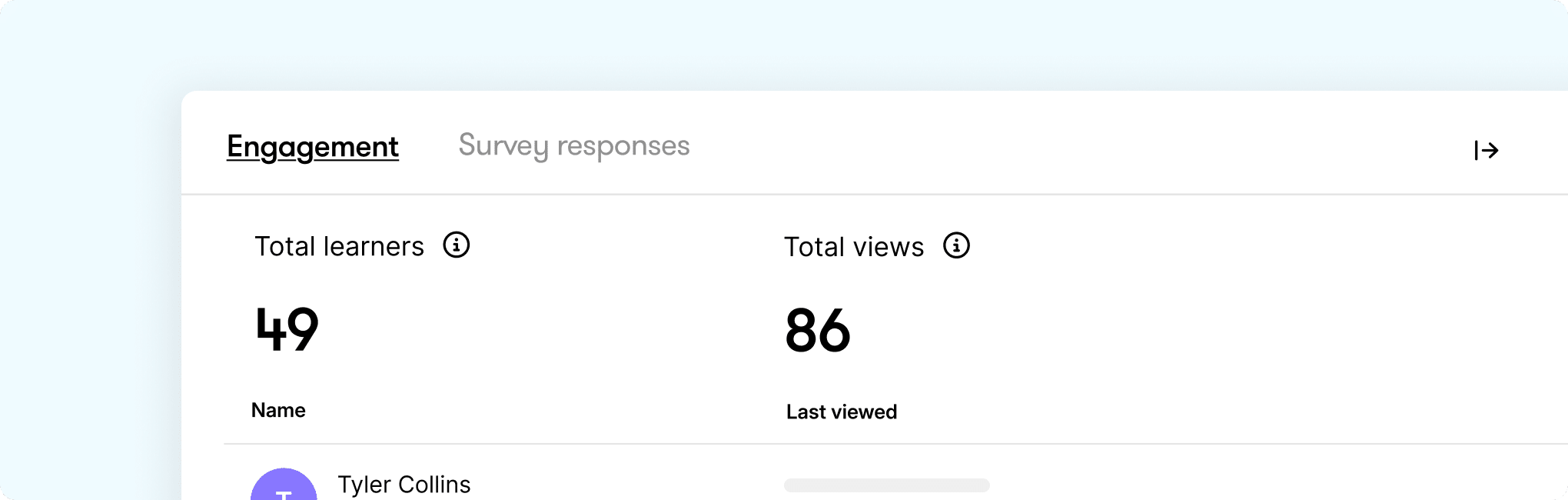
Insights in Articulate 360 AI
This is the difference between shipping information and changing behavior.
The question worth asking
The traditional workflow is: product ships, create content, send it out, hope something sticks. What I’ve learned is that hoping something sticks is not a strategy.
The only question that actually predicts revenue impact is whether your rep, your CS manager, or your customer education lead can explain the product accurately under pressure to a skeptical buyer. Not pass a quiz. Explain it, live, in a real conversation.
AI has made the work to get there dramatically faster. The raw material already exists in your product brief, your objection handling sheet, your call recordings. What used to take days to turn into structured practice now takes minutes. The question is whether you use it to build something your team works through, or something they scroll past.
If your product team shipped a major release tomorrow, how long before every customer-facing person could accurately walk a prospect through it? For most organizations, the honest answer is: longer than your product release cycle. That’s the gap. And it’s yours to close.
ABOUT THE AUTHOR

Sam Shoemaker leads Sales and Business Development at Articulate. Before joining Articulate, she spent 15 years in sales leadership at AMEX Global Business Travel, Expedia, and Groupon.