




Tom – you have it exactly right here. We all too often forget about the power of relevancy. A good reminder.
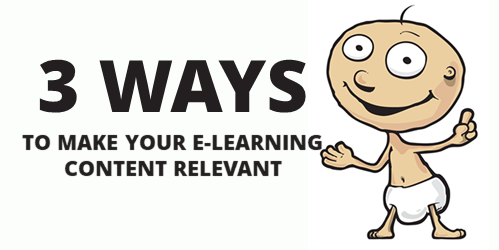
Earlier today, I got an email about a baby moose that was born in someone’s front yard. As I looked over the email, I noticed that the ads on the side were pushing baby showers and buying cute baby outfits.
By design these ads create relevant links based on the text of the email. In this case the links were not relevant and completely out of the context of the email I was reading. I don’t need cute baby outfits. So I just ignored the ads. That’s what happens when you just create ads oblivious to the needs of a real person.
There’s a lesson in here for those of us who design e-learning. Want your learners to learn? Then create relevant content. If not they’ll ignore what they see in the course. It all goes back to a point I was making in the last post about understanding the learner’s needs. To have the most impact, the course needs to be relevant to the learner.
Don’t get caught trying to sell baby gifts to someone reading about a moose.
Three Ways to Make Your E-Learning Content Relevant
1. Spend time with the learners in their environment.
A while back, I worked on a course for machine operators in a production environment. Much of the job was loading and unloading a high-speed machine. After spending a few days on the floor talking to the machine operators, I found that the machine intimidated many of the new users. It was extremely large, fast, and noisy. On top of that, the new users were continually reminded of how expensive it was and to not mess up anything. This affected their performance.
I learned a lot talking to and observing the machine operators. Because of the time spent with them, we built the core part of the training around preventive maintenance on the machine. Before they learned to operate the machine, they learned to take it apart, clean it, and put it back together. By the time they started working on the machine, they were no longer intimidated. As a result we ended up cutting a 90-day training process down to less than 2 weeks.
2. Be a bridge between the content owner and the learner.
Typically, courses are built around the needs of the organization or content owner. Many times this happens oblivious to the learner’s needs. Part of your role is to blend the organization’s needs with the learner’s needs.
It’s important to get the learners involved in the development and design of the user training. Learners are able to build a context for the information. New learners are especially valuable because they can share recent experiences and insights while they are still fresh.
3. Put the content in context.
In face-to-face sessions, you can get a lot of mileage when you step away from a lecture format and allow people to work through scenario-based challenges. It keeps the information meaningful and the learners are motivated to learn.
You can do something similar with e-learning. Page after page of content is equal to an online lecture. Change things up. Create branched scenarios and real-world interactions where the learner gets to practice using the information in a way that is relevant to the real-world environment.
You don’t want your learners to tune out and discount the important courses that you build. If you get them involved and keep the content relevant, you’ll have engaged learners.
What are some things you do to keep your elearning courses relevant?
By the way, here’s that moose. Although, I opted not to throw a baby shower or buy it a new outfit.

Events
- Everyday. Check out the weekly training webinars to learn more about Rise, Storyline, and instructional design.
Free E-Learning Resources
 |
 |
 |
|
Want to learn more? Check out these articles and free resources in the community. |
Here’s a great job board for e-learning, instructional design, and training jobs |
Participate in the weekly e-learning challenges to sharpen your skills |
 |
 |
 |
|
Get your free PowerPoint templates and free graphics & stock images. |
Lots of cool e-learning examples to check out and find inspiration. |
Getting Started? This e-learning 101 series and the free e-books will help. |

You might also like:
14 responses to “Instead of Relevant Content, Maybe All Your Learner Needs Is a Baby Shower”
If there’s one takeaway here for me, it’s “get the learners involved.” I’ve been burned in the past when I’ve worked only with management. The learners are your reality check. Get them involved early and often!
Excellent points about context, and using scenarios and interactions to liven up the material.
Too often, my clients seem to think they can simply copy-and-paste entire manuals into PowerPoint presentations and that doing so somehow magically transforms them into e-learning courses. Even the best Instructional Designers need to understand the differences in the media and how learners respond in an online environment.
Thanks for making this point so clearly and concisely!
When taking my pedagogical classes I learned that the most important think to keep in mind when teaching something is that it needs to be USEFULL for the learner. As you say Tom, get learners involve in their learning process is the most significant part of this process.
You ask “What are some things you do to keep your elearning courses relevant?”. Well, one thing I keep in mind is to produce materials that are coherent with the social context. I cannot think of teaching nutritional facts in a place where people die of starvation, for example.
My company was awarded a pilot project on e-learning for about 2000 healthcare staff in Malaysia.The first complaint was the relevance of the subject matter since we had only 11 courses on-line. We had expected this response since the healthcare needs are as varied as the ailments they deal with. The only solution is to develop a set of basic courses for everyone first and then compliment it with speciality course later on. This would mean that we will end up with 300-400 courses on-line.
The other problem I am facing is that the customer has asked us to measure the improvements for a nationwide project. Having read Tom’s e-book, I’m at assured that I’m not the only one facing this problem. Help!
Thanks Tom
Hi Tom.
I find this tips very usefull, congratulations!!!!!!
Thanks a lot
Claudia V
[…] Maybe All Your Learner Needs Is a Baby Shower […]
[…] […]
[…] Maybe All Your Learner Needs Is a Baby Shower Your E-Learning Success Depends on These 7 Questions Many times you get projects where the customer has already determined what she wants. construire une formation pour le Elearning e-learning Apprendre avec et en numérique FOAD cognition [+] elluminate inicio portfolio apprendre concevoir creation de contenu présentation Digital Literacy NHS everything ELEARNING mapping voûte innovation Psycho relation – commu comprendre guide modèles eLearning Methodology animer bloom elearning Strategies savoirs Outils existants carte créer partage Methodologie guide conception Ingenierie cours production tutorat Apprendre apprentissage annexes neuroéducation e learning et e formation grille e_learning_documents formateurs Médias sociaux et éducation application immersif Apprentissages objet Impact, Evidence and Evaluation issues enhances ejournal PédagoTice ancien ressources livres Online Learning discussion Evaluation bâtir TICE usages ludovia apprentissages formation des enseignants nouveaux incontrano Tic et apprentissages formation drawings TICE twitter lecture Méthodologie gagner conception tgrh reveal contrat sciences Apprendre vidéos comptabilité thinkbuzan EVALUATION etudier ligne evaluations Didactique soutien prélever classe Théorie centre teaching pedagogie et heuristique devenir lettres carte Elearning communautés formation développement Conduite de projet & Dispositifs label Guides Rapid elearning, cours, présentations Articulate Studio et Storyline Logiciels auteurs Rapid e-learning home • contact • blog • fb • twitter to experience pearltrees activate javascript. […]


0
comments